Ulna: anatomy, landmarks and muscle attachments
The ulna is the medial bone of the forearm, on the little finger side. Learn its olecranon, coronoid process and trochlear notch, how it forms the elbow hinge, and the muscles that attach to it.
Quick answer
- Latin name
- Ulna
- Type
- Long bone
- Location
- Medial (little finger) side of the forearm
- Main landmarks
- Olecranon, coronoid process, trochlear notch, radial notch, ulnar tuberosity, head, styloid process
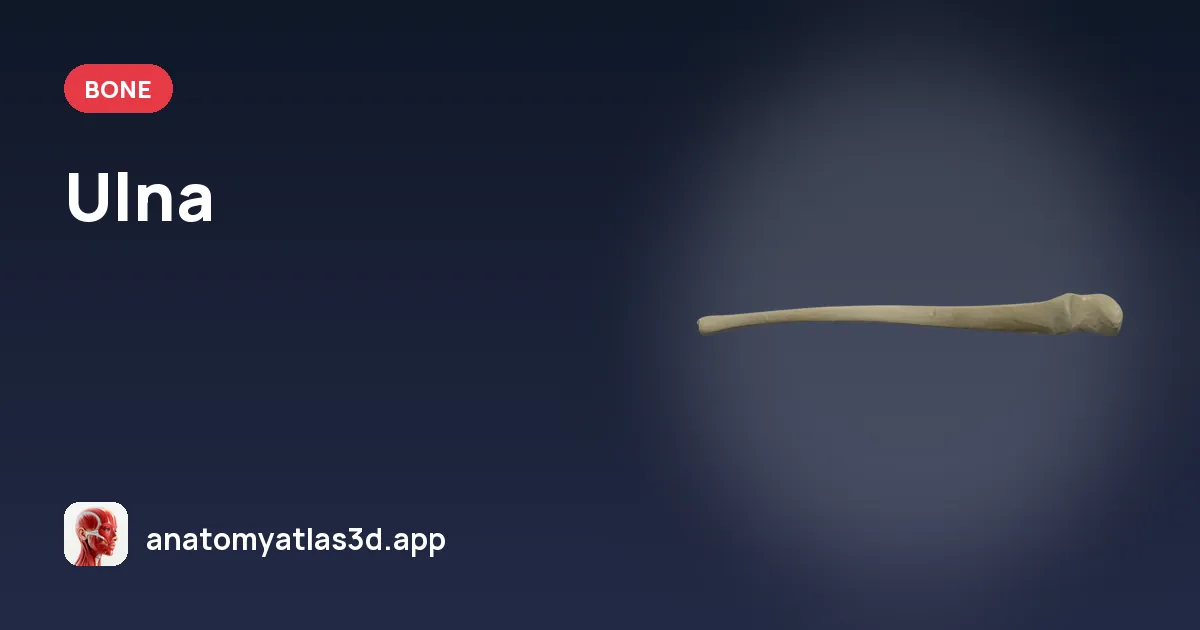
The ulna is the forearm bone on the little finger side. It's thick at the elbow, where it forms the main hinge with the humerus, and thin at the wrist.
Upper end
- The olecranon is the bony point of the elbow. The triceps brachii inserts on it.
- The coronoid process juts forward below it. Between them, the C-shaped trochlear notch wraps around the trochlea of the humerus to form the elbow hinge.
- The radial notch, on the lateral side, holds the head of the radius.
- The ulnar tuberosity, below the coronoid process, receives the brachialis.
Shaft
Like the radius, it has an interosseous border for the interosseous membrane. Many forearm muscles, flexors in front and extensors behind, take origin from its shaft.
Lower end
- The small head sits at the wrist, on the little finger side, separated from the carpal bones by a cartilage disc.
- The styloid process projects behind it. You can feel it on the back of the wrist.
Frequently asked questions
Which side of the forearm is the ulna on?
The medial side, in line with the little finger.
What is the olecranon?
The bony point of the elbow, at the top of the ulna, where the triceps inserts.
Does the ulna move in pronation?
Barely. The radius rotates around the ulna, which stays almost still.