Scapula: anatomy, landmarks and muscle attachments
The scapula, or shoulder blade, is a flat triangular bone on the back of the thorax. Learn its borders, angles, spine, acromion, coracoid process and glenoid cavity, and the 17 or so muscles that attach to it.
Quick answer
- Latin name
- Scapula
- Type
- Flat bone
- Location
- Upper back, over ribs 2 to 7
- Main landmarks
- Medial, lateral and superior borders; superior and inferior angles; spine; acromion; coracoid process; glenoid cavity; supraspinous, infraspinous and subscapular fossae; supraglenoid and infraglenoid tubercles
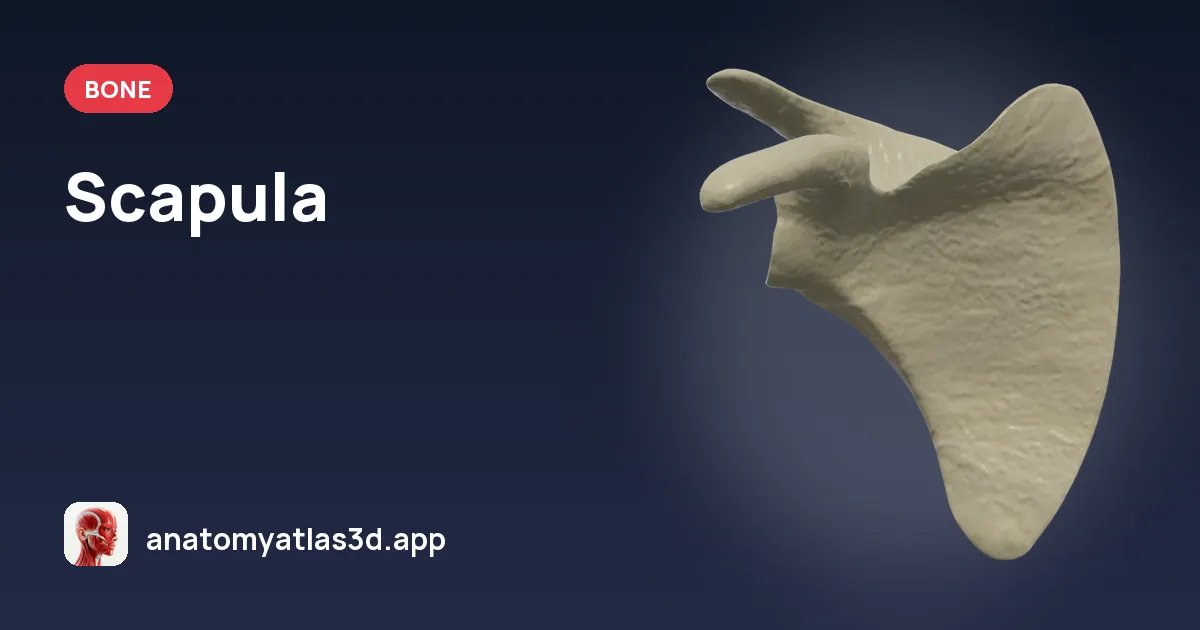
The scapula is a flat, triangular bone that glides over the back of the ribcage. It isn't fixed to the ribs: muscles hold it in place, which lets it move with the arm and give the shoulder its huge range of motion.
Borders and angles
- Three borders: medial (near the spine), lateral (towards the armpit) and superior.
- Three angles: superior, inferior and lateral, where the glenoid cavity sits.
Surfaces and fossae
- The front (costal) surface is the subscapular fossa, filled by the subscapularis. The serratus anterior inserts along its medial border.
- The back is divided by the spine into the supraspinous fossa (supraspinatus) and the infraspinous fossa (infraspinatus).
Processes
- The spine ends laterally in the acromion, the bony tip of the shoulder, which articulates with the clavicle. The trapezius inserts on the spine and acromion; the deltoid starts there.
- The coracoid process hooks forward under the clavicle. It anchors the pectoralis minor, the coracobrachialis and the short head of the biceps.
- The glenoid cavity is the shallow socket of the shoulder joint, with the supraglenoid tubercle above (long head of biceps) and the infraglenoid tubercle below (long head of triceps).
Frequently asked questions
Why is the scapula so mobile?
It's held to the trunk by muscles rather than joints, with only one small bony link (the acromioclavicular joint).
What muscles attach to the coracoid process?
The pectoralis minor, the coracobrachialis and the short head of the biceps brachii.
What is the glenoid cavity?
The shallow socket on the lateral angle of the scapula that receives the head of the humerus.